Everyday kindness contrasted with selfishness
The Thursday Murder ClubEveryday kindness contrasted with selfishness is presented through Joyce’s recollection of a fall in Fairhaven and her conflicted response to Ian Ventham’s death. The contrast is not simply between good and bad people: Joyce sees kindness as a common human impulse, yet acknowledges that some people act as though the world belongs to them. Her preference that Ventham, rather than someone she loves or an ordinary stranger, died makes that distinction intimate and morally uneasy.
The fall in Fairhaven
A few weeks before recording this reflection, Joyce tripped over a loose paving slab in Fairhaven. She had not written about it in her diary, which had been occupied by murders, trips to London, and her pursuit of Bernard. The fall was serious enough to leave her shaken; her bag dropped, scattering her keys, glasses case, pills, and phone. The small objects make the incident concrete: for a moment, the ordinary things she carried were out of reach, and she needed help to gather herself and her belongings.
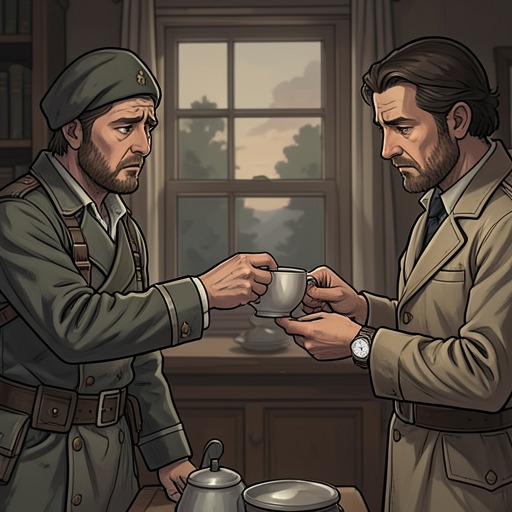
The response came from several people, each offering a different practical kindness. A cyclist helped Joyce to her feet. A traffic warden picked up her things and dusted down her bag. A woman with a pushchair sat with her at a pavement table until she had recovered her breath. The café owner brought tea and offered to drive her to her general practitioner. No one gesture stands alone as a grand act; together, these unsolicited responses turn an accident into evidence of people attending to one another.
Joyce considers whether the help came only because she looked old, frail, and helpless. She does not settle on that explanation. Instead, she imagines the same people helping a fit young person who had taken the same fall: the cyclist giving him a hand, the traffic warden retrieving a laptop, the café owner making the same offer of a ride. Her imagined reversal tests whether compassion depends on visible vulnerability. Joyce concludes that it does not have to: she believes she would have helped, and expects the others would have done so too.
Kindness as an ordinary impulse
The incident supports Joyce’s broader belief that people are, for the most part, kind. Its force comes from the difference between the everyday scale of the acts and the larger claim she draws from them. The strangers do not need to know Joyce or to share her concerns; their kindness appears in noticing a person who has fallen and responding with whatever assistance is at hand. The account therefore locates goodness not in exceptional heroism but in practical attention.
At the same time, Joyce’s reflection is not an uncomplicated assertion that everyone is generous. Her qualification matters: most people are kind, but a few have always been awful. She rejects the notion that selfishness is necessarily a new condition, even as she recognizes people who behave as though they alone have a claim on the world. Kindness is common in her view, not universal. That distinction lets her hold on to an optimistic account of human nature without denying the people whose conduct contradicts it.
The selfish figure and the remembered consultant
Joyce explains her judgment of Ventham by recalling a consultant with whom she had once worked at Brighton General, high on the hill. She remembers him as rude, cruel, and unhappy. He shouted at staff and blamed them for errors that he himself had made. In Joyce’s recollection, his authority did not make him considerate; instead, he used it to make other people’s lives miserable. Her admission that she would have danced if he had dropped dead in front of her establishes how strongly she resented him.
Ventham recalls that consultant to Joyce because she places them in the same moral category. The coincidence that both men were called Ian becomes, in her account, something to watch for, but her comparison rests on more than the shared name: she sees Ventham as another person who treated the world as his alone. Against the strangers who respond to a fall with help, these men represent the opposite pattern—using their position or presence to make others bear the consequences of their behavior.
Death, preference, and moral discomfort
Joyce’s response to Ventham’s death preserves a tension rather than resolving it. She is sorry in one sense that he is dead, but immediately sets that feeling beside the many deaths that occur each day. She does not know the statistics; her point is that someone was going to die, and she would rather it had been Ventham than the cyclist, the traffic warden, the mother with the pushchair, or the café owner. The list returns the reflection to the particular people who helped her, setting their ordinary generosity against the selfishness she associates with Ventham.
Her comparison extends to people close to her: Joanna, Elizabeth, Ron, Ibrahim, Bernard, and Joyce herself. She would rather the fatal outcome had fallen on Ventham than on any of them. The admission is deliberately personal. Joyce knows that this preference might sound selfish, and does not pretend to stand outside the arithmetic of survival; she includes herself among those she would rather see spared. Her sympathy for a dead man therefore coexists with relief that someone else died instead.
The thought ends by placing Ventham’s death within the unavoidable fact of mortality. Joyce reasons that everyone has a day when life ends, and that the day in question was Ventham’s, though she doubts he expected it when he woke that morning. Elizabeth says he was killed, and Joyce trusts Elizabeth’s judgment. That final qualification separates the certainty of death from the circumstances of it: Joyce accepts that Ventham’s death was not merely an ordinary passing, while the larger reflection remains fixed on how people treat one another before such a day arrives. The strangers’ help and Ventham’s selfishness become opposing examples within an account that neither idealizes humanity nor erases its capacity for kindness.